- Federal law
- Fair Labor Standards Act
- For-profit businesses
- Generally can't use volunteers
- Nonprofits
- Can, for charitable work only
- Public agencies
- Can, in most cases
- Paid staff
- Can't volunteer their own job
- California
- Stricter: intent and organization type decide
- Key question
- Who are you working for?
Key characteristics
Depends on the organization The same task can be volunteering for a charity and a paid job for a business.
No expectation of pay A volunteer gives time freely, without being promised or expecting wages.
Charitable work, not commercial work Running a shop or selling to the public is paid work, even at a nonprofit.
Staff can't donate their own job Paid employees can't volunteer the same type of work they're hired to do.
Volunteer vs employee vs related terms
Volunteer vs employee, in plain words
A volunteer gives time freely, for a civic, charitable, religious or humanitarian cause, and doesn't expect to be paid. An employee works and is owed at least minimum wage. The hard part is that the same task, like scanning tickets, can be either one. It depends on who you're working for.
Say a music festival asks you to “volunteer” at the merch tent in exchange for a free wristband. If a for-profit company runs that festival, the federal government doesn't see a volunteer. It sees an employee who hasn't been paid.
That's the core of it. Now let's look at the actual rule.
The federal rule: for-profit businesses can't use volunteers
The federal wage law, the Fair Labor Standards Act (FLSA), sets the baseline. The U.S. Department of Labor puts it simply: employees may not volunteer services to for-profit private sector employers.
Nonprofits and government agencies are different. Under the Labor Department's Fact Sheet #14A, someone generally isn't an employee if they volunteer freely for public service, religious or humanitarian goals, and without expecting or receiving pay. In most cases, people can also volunteer for public sector employers like a city or county.
| For-profit business | Nonprofit | Public agency | |
|---|---|---|---|
| Unpaid volunteers? | Generally no | Yes, for its charitable work | Yes, in most cases |
| Main limits | Work for a business is paid work | No volunteers in commercial activities; paid staff can't volunteer their own job | The person must still give time freely, with no expectation of pay |
| Event example | A concert promoter, catering company or brand activation agency | A charity 5K or a food bank's fundraising gala | A city's parade or a public library festival |
So the first question is never “Did I agree to work for free?” It's “Who am I working for?”
Where nonprofits hit the limit
Being a nonprofit doesn't make every unpaid shift legal. The Labor Department draws two lines.
- No volunteering in a business. People generally may not volunteer in commercial activities a nonprofit runs, like a gift shop. Selling things to the public looks like a business, so it's paid work.
- Paid staff can't volunteer their own job. A nonprofit's employees can't volunteer to do the same kind of work they're paid to do. A 2026 Labor Department opinion letter repeats this: they can volunteer only freely, with no expectation of pay, and not in the same type of work.
Mega-events: Olympics, Super Bowl, World Cup
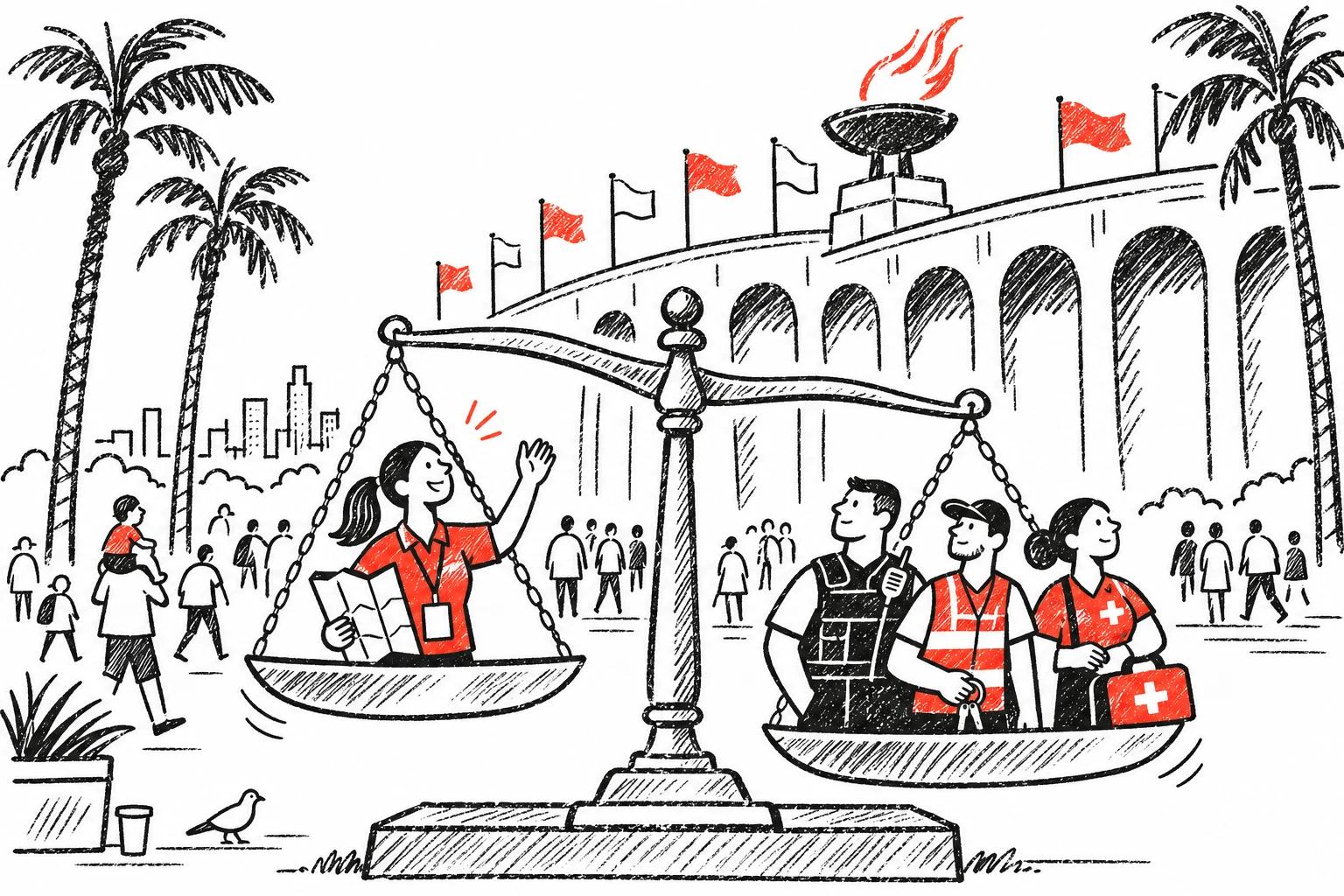
Big events follow a pattern. A host committee or organizing committee runs a volunteer program for welcome and community roles. Most of the hands-on work, like security, food, cleaning and transport, goes to paid staff and contractors.
| Event | Volunteers | Paid work |
|---|---|---|
| Paris 2024 Olympics | 45,000 volunteers, from more than 300,000 applicants | About 16,000 paid openings in catering, cleaning, transport and security (per AFP) |
| LA28 Olympics | About 60,000 roles, at least 10 eight-hour shifts each; travel and lodging not covered | A Games workforce of nearly 5,000, with contractors holding much of the Games-time labor |
| Super Bowl LVI, Los Angeles (2022) | The host committee hired paid temps through its Teammate Program | More than 4,000 paid temps at $19 to $30 an hour (2021 figures) |
If you want paid work around a mega-event, look past the volunteer portal. Check the committee's own careers page and the contractors that run security, food and transport. Our coverage of LA28's volunteer plans goes deeper on where the line between a gift and a job sits.
Your state can be stricter: California
Federal law is the floor. States can set tighter rules, and California does.
California's Labor Commissioner has said that someone “volunteering” for a for-profit business to gain experience, or to get some other benefit, is treated as an employee. That person is owed at least minimum wage and overtime. A bona fide volunteer is someone who serves a public agency, a religious or humanitarian group, or a similar nonprofit, with no expectation of pay.
In the Commissioner's words, the type of organization and the intent of both sides is “controlling.” It's also why the Bay Area Super Bowl host committee's FAQ says state law allows unpaid roles only for charities and local government.
Red flags that “volunteering” is really a job
Decide in four steps
Who runs the event and who benefits?
If a for-profit company runs it or profits from your work, treat it as a job. Under federal law, it must pay you.
Is the work charitable, civic or religious?
Helping a nonprofit or public agency with its mission can be volunteering. Running its shop, bar or concession stand is closer to a business.
Are you giving the time freely?
A real volunteer expects no pay and isn't pressured. If someone hints that a paid shift depends on a free one, that's a job audition.
Do you already work there?
If you're on their payroll, you can't volunteer to do the same kind of work you're paid for.
If any answer points to a job, it's a job. Ask for pay in writing, or ask who your employer is. Our guide to W-2 vs 1099 event staff explains what being on a payroll gets you.
Common questions
This is a plain-English summary, not legal advice. If you think you were owed pay for “volunteer” work, contact your state labor department or the U.S. Department of Labor's Wage and Hour Division.
Best practices
Ask who the employer is Get the name of the organization running the event in writing before your shift.
Keep a record of your hours If an unpaid role turns out to be a job, your notes support a wage claim.
Common mistakes
Agreeing to unpaid trial shifts At a for-profit business, real work during a trial is generally paid work.
Assuming any charity event is volunteer work Commercial activities like concession sales are generally paid work, even for a nonprofit.
Taking perks instead of pay A free ticket or meal doesn't make work for a business into volunteering.
Ignoring state law California and other states can be stricter than the federal rule.