On the shift
An event shift runs on a few fixed points: call time, the briefing, your post, your breaks and strike. These six chapters cover call time, the event staff dress code, break laws, briefings and what happens at load-out.
Call time is when you must be at your post, dressed and ready to work, not when you arrive at the venue. Federal law requires no meal or rest breaks, but some states do: California, Colorado, Oregon and Washington require a paid 10-minute rest break per 4 hours worked.
Low $20, median $26 an hour, High $38
Plus tips on most shifts. Shifts on eventstaffing.com, 2026-09.
What does call time mean for event staff?
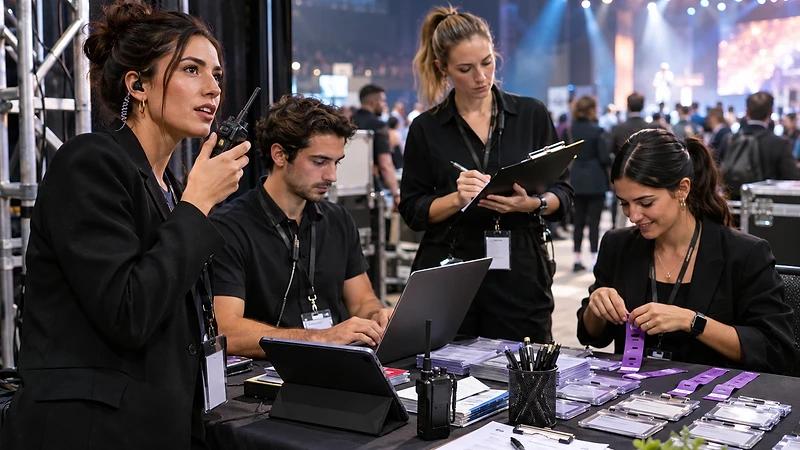
Call time is when you are at your post, dressed and ready to work, not when you park. For a 4:00 pm call with 6:00 pm doors, be checked in and in uniform by 4:00. Leads take attendance at call, and a no-call, no-show is the fastest way to stop getting booked.
Calls are staggered: load-in crew come hours early, ushers closer to doors. Time you are required to wait on site is generally work time under federal rules, so ask whether an early uniform pickup is paid.
Event staff dress code: what to wear and bring
The shift details name the dress code; if they don't, ask the agency the day before, not at check-in. Whatever the code, wear shoes you can stand in for eight hours. Front-of-house staff are seen by every guest, so leads check them hardest.
- All blacks: black button-down or polo, black pants (not jeans) and black non-slip, closed-toe shoes.
- Black and white: white collared button-down, black pants or skirt, black shoes. Standard for banquet servers.
- Brand uniform: the client's shirt or jacket with your own black pants, typical for brand activations.
Are breaks required by law?
Not under federal law. The Fair Labor Standards Act does not require meal or rest breaks; it only sets how breaks count. Short breaks of about 5 to 20 minutes are paid work time, according to the U.S. Department of Labor.
Myth or fact?“Federal law says I get a break every four hours.”
The FLSA requires no break at any point in a shift. The paid 10-minute rest break per 4 hours worked comes from state rules, such as those in California and Washington.
Source: State meal period and rest period requirements for adult employees in private employmentMeal and rest break laws by state
Some states require meal periods or paid rest breaks; many require neither. California requires a 30-minute meal period for work periods over 5 hours. Texas and Florida are not in the Department of Labor's state tables, so the employer's policy decides. Confirm the current rule with your state labor office.
- Official source
- dol.gov (opens in a new tab)
- Notes
- Meal: 30 minutes over 5 hours, a second over 10. Rest: paid 10 minutes per 4 hours.
At events, breaks are staggered so a bar or door is never empty, and a long day may be a split shift.
Briefings, posts and the run of show
After call, the lead briefs you on the event flow, your post, who you report to, the break order and specials such as VIP arrivals or a hard stop on bar service. It comes from the run of show, and you only need the lines that affect your post; our run of show template shows which ones each role watches.
An usher on a door is part of the exit plan, so never leave a post uncovered: tell your lead and wait to be relieved.
- Phone away unless it is a work tool.
- No eating or drinking in guest view, and no alcohol on shift.
- Don't argue with a guest. Bring in your lead for complaints and refusals.
- Stay until you are released. The lead signs you out, not the clock.
What does strike mean at an event?
Strike is the teardown after the last guest leaves: the stage, bars, signage and decor come down. On the schedule it often shows up as the load-out, when gear goes back on the trucks. Expect it to be physical and to run late.
Stagehands and setup crew may work the whole strike. Servers and bartenders break down their stations, count back stock and return kits before release. Find shifts on the jobs board.
Questions people ask
Under federal law, yes: the FLSA does not require a break at any point in a shift. In California, Colorado, Oregon and Washington the basic rule is a paid 10-minute rest break per 4 hours worked. Check your state labor office.
It depends on the state. Federal law requires none. Under California's basic rules, a 9-hour shift means one 30-minute meal period and two paid 10-minute rest breaks. Elsewhere the employer's policy may decide, so ask at the briefing.
Call time is when you must be on site, dressed and ready to work, not when the shoot or event starts. Crew are usually called earlier because they set up first. See call time in our glossary.
A white collared button-down shirt, black pants or a black skirt and black closed-toe shoes. Some caterers add a black vest, tie or apron. It is the usual dress code for banquet servers and catering staff.