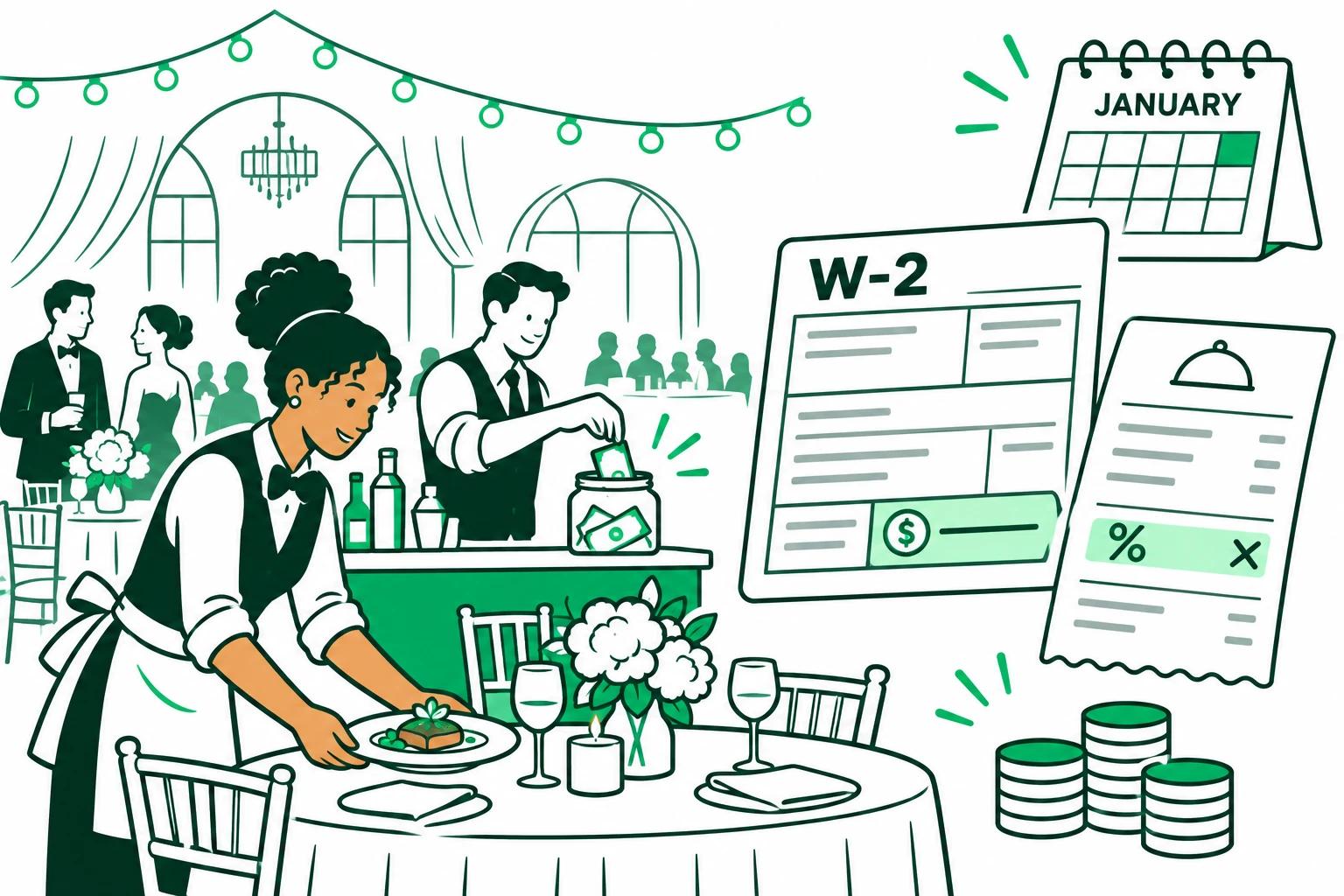
- Report to employer if
- $20 or more in tips in a month
- Report due
- By the 10th of the next month
- Taxes withheld
- Income tax, Social Security and Medicare
- W-2 tip boxes
- Box 7, Box 8, Box 12 (A, B, TP), Box 14b
- Allocated tips trigger
- Reported tips under 8% of sales
- Federal tip deduction
- Up to $25,000 a year, 2025–2028
- Official guide
- IRS tip recordkeeping
Key characteristics
Monthly, not yearly Reports go to your employer by the 10th of the month after you got the tips.
Covers every kind of tip Cash, card and tip pool money all count. Non-cash gifts go on your own return.
Taxes come out of your wages Your employer withholds tax on reported tips from your regular pay.
Unlocks the tip deduction Reported tips on your W-2 back up the 2025–2028 qualified tips deduction.
Tip reporting vs related terms
What is tip reporting?
Tip reporting is how your tips get onto the tax record. It happens in two steps. First, you tell your employer what you made in tips. Then your employer adds them to your pay records, takes out taxes and reports them to the IRS on your W-2.
Why bother? Reported tips go on your W-2, and Social Security and Medicare tax is paid on them, so they count toward your Social Security record. They also back up the new federal deduction for tips.
How to report tips to your employer
Here's the routine. It takes a few minutes a month if you keep up with it.
Keep a daily record
Write down your tips each shift: cash, card and anything you get from a tip pool or tip-out. An app, a notebook or your employer's system all work. The old IRS Form 4070 has been retired; employers can take reports electronically, or you can give a signed, dated statement for the month.
Add up the month
If your tips from one employer reach $20 or more in a calendar month, you must report them to that employer.
Report by the 10th
Your report is due by the 10th of the following month. If the 10th falls on a weekend or holiday, it's due the next business day.
Keep non-cash tips separate
Tickets or gifts from guests aren't reported to your employer. Note the date and value, and include them on your own tax return.
What your employer takes out
Once you report, your employer treats tips like wages. It takes out income tax plus your share of Social Security and Medicare, and pays its own share on top.
Tips don't come with a paycheck, so the tax comes out of your regular wages. On a low-wage, big-tip week, there may not be enough pay to cover it. Whatever your employer can't collect shows up on your W-2, and you pay it with your tax return.
Reading your W-2
Your W-2 shows your tips in a few places. The 2026 form adds two new spots for tipped workers.
| Box | What it shows |
|---|---|
| Boxes 1, 5 and 7 | Reported tips are included in your wages (Box 1) and Medicare wages (Box 5). Box 7 shows your Social Security tips. |
| Box 8 | Allocated tips. These are not included in Boxes 1, 5 or 7. |
| Box 12, code A | Social Security tax on tips your employer couldn't collect. |
| Box 12, code B | Medicare tax on tips your employer couldn't collect. |
| Box 12, code TP (new for 2026) | The total cash tips you reported to your employer. |
| Box 14b (new for 2026) | Your tipped occupation code from the IRS list. Up to two codes if you work two tipped jobs. |
Allocated tips: the 8% rule
Some workplaces must check that tip reports look realistic. It applies to large food and beverage businesses: places in the U.S. that serve food or drinks to eat on site, where tipping is customary, and that usually had more than 10 employees on a typical day last year.
If reported tips add up to less than 8% of the business's sales, the employer splits the gap among tipped staff. That share is your allocated tips, in Box 8. Nothing is taken out for it, but you include it as income on your return unless your own records show you got less.
No tax on tips: the qualified tips deduction
From 2025 through 2028, you can deduct qualified tips from your federal taxable income. It doesn't make tips tax-free across the board, so it helps to know the limits.
- Most you can deduct per return
- $25,000
- Tax years covered
- 2025–2028
- Starts shrinking above (single)
- $150,000 income
- Starts shrinking above (joint)
- $300,000 income
Above those income levels, the deduction drops by $100 for every $1,000 over. Only voluntary tips in jobs on the IRS list of tipped occupations count, and banquet staff and bartenders are on it. Service charges don't qualify, and Social Security and Medicare are still owed on every tip. You claim it on Schedule 1-A, and many states don't follow it. Our qualified tips entry has the full rules.
If you work as a 1099 contractor
Some event workers are paid as independent contractors, not employees. There's no employer to report to, so you include tips in your own business income on your return. Self-employment tax covers your Social Security and Medicare.
Contractors can claim the qualified tips deduction too, but only up to the business's income after expenses. This is a plain-English summary, not tax advice. A tax preparer can tell you what applies to your return.
Common questions
Best practices
Log tips the night you earn them A quick note each shift beats guessing at the end of the month.
Check your Box 14b code Ask payroll which tipped occupation code they're using for you.
Common mistakes
Skipping cash tips Cash tips are income. Unreported tips still need Form 4137 at tax time.
Missing the 10th Late or missing reports leave tips off your W-2, which is the record the IRS sees.
Thinking no tax on tips means no tax Social Security and Medicare still apply, and many states still tax tips.
Counting a service charge as a qualified tip Fixed charges the guest can't change are wages, not tips, and don't qualify.