- Signed by
- A union and an employer
- Federal law
- National Labor Relations Act
- Usually covers
- Wages, hours, benefits, seniority, work rules
- Who it covers
- Everyone in the bargaining group, members or not
- U.S. coverage, 2025
- 11.2% of wage and salary workers
- Hotel coverage, 2025
- 8.3% of accommodation workers
- Right-to-work states
- 26, as of 2026
- Notice to change it
- 60 days before it expires
Key characteristics
Bargained for a group The union negotiates once for everyone in the group instead of each worker alone.
Covers members and non-members Everyone in the bargaining group works under it, whether or not they join.
Has an end date When it nears expiration, both sides bargain the next one.
Set venue by venue Each contract covers a specific employer or group of employers and jobs.
Collective bargaining agreement vs related terms
Why two banquet jobs in the same city pay differently
Two banquet servers work Saturday weddings in the same city. One has a set pay scale, a share of the service charge and health insurance. The other has a different rate and none of those extras. Very often, the difference is one document: a collective bargaining agreement, or CBA.
A CBA is a written contract between a union and an employer. Instead of each worker negotiating alone, the union bargains for the whole group at once. That’s the “collective” part.
The right to do this comes from the federal labor law, the National Labor Relations Act. It requires employers and unions to bargain in good faith over wages, hours and other working conditions.
What a CBA covers
Every contract is different, but most cover the same ground. Here’s what to look for if you ever get to read one.
- Wages
Pay scales for each job and the raises over the life of the contract.
- Service charges
Some hotel contracts give banquet staff a share of the service charge. In one Chicago court case from 1986, the union contract paid banquet waiters a daily wage plus an equal share of a 16% service charge.
- Premiums
Extra pay the contract sets for things like overtime, holidays or long event days.
- Benefits
Health insurance, pensions and paid time off.
- Seniority
Who gets offered shifts first, and the order for cutbacks in slow seasons.
- Jurisdiction
Which workers, and which union, do which jobs.
- Disputes
How complaints get raised and settled while the contract runs.
- Term
How long the contract lasts before it has to be bargained again.
Unions you’ll meet at events
Event work touches several unions. UNITE HERE represents many hotel, casino and food service workers, including banquet servers, bartenders and cooks. IATSE represents stagehands and other stage crews. The Teamsters often handle freight at trade shows, and the IBEW handles electrical work.
Who does what is set venue by venue, by contract. Here’s how one big convention center splits the work.
| Work | Union |
|---|---|
| Freight and material handling, load-in and load-out | Teamsters Local 2785 |
| Installing and dismantling exhibits, signs and displays | Sign and Display Workers Local 510 |
| Staging, rigging, theatrical lighting, sound and AV | IATSE Local 16 |
| Electrical service to exhibit booths | IBEW Local 6 |
| Food and beverage | Hotel and Restaurant Workers Union Local 2 |
| Telephone services | Communications Workers of America (CWA) |
Another city will split it differently. If you’re planning a show, the general service contractor or AV provider can tell you which union handles what.
Union states vs. right-to-work states
Federal law lets each state decide one big question: can a union contract require workers to pay the union? In 26 states, right-to-work laws say no. There, you can’t be made to join or pay a union to keep your job. Michigan dropped its right-to-work law in 2024.
In the other states, a contract can require the workers it covers to pay the union. Either way, a CBA covers everyone in the group it was bargained for, members or not. In 2025, 1.8 million U.S. workers were covered by a union contract without being members.
How common is a contract in your line of work? It depends a lot on where you work.
- All workers11.2%
- Accommodation (hotels)8.3%
- Private sector6.8%
- Arts, entertainment and recreation6.1%
- Leisure and hospitality3.5%
- Food services and drinking places2.2%
Source: Union Members 2025 (Table 3) · As of Dec 2025
Hotels stand out. About 1 in 12 hotel workers is covered by a union contract, far more than in restaurants and bars.
What happens when a contract expires
A CBA has an end date. When it gets close, both sides sit down to bargain the next one. Federal law sets a few steps along the way.
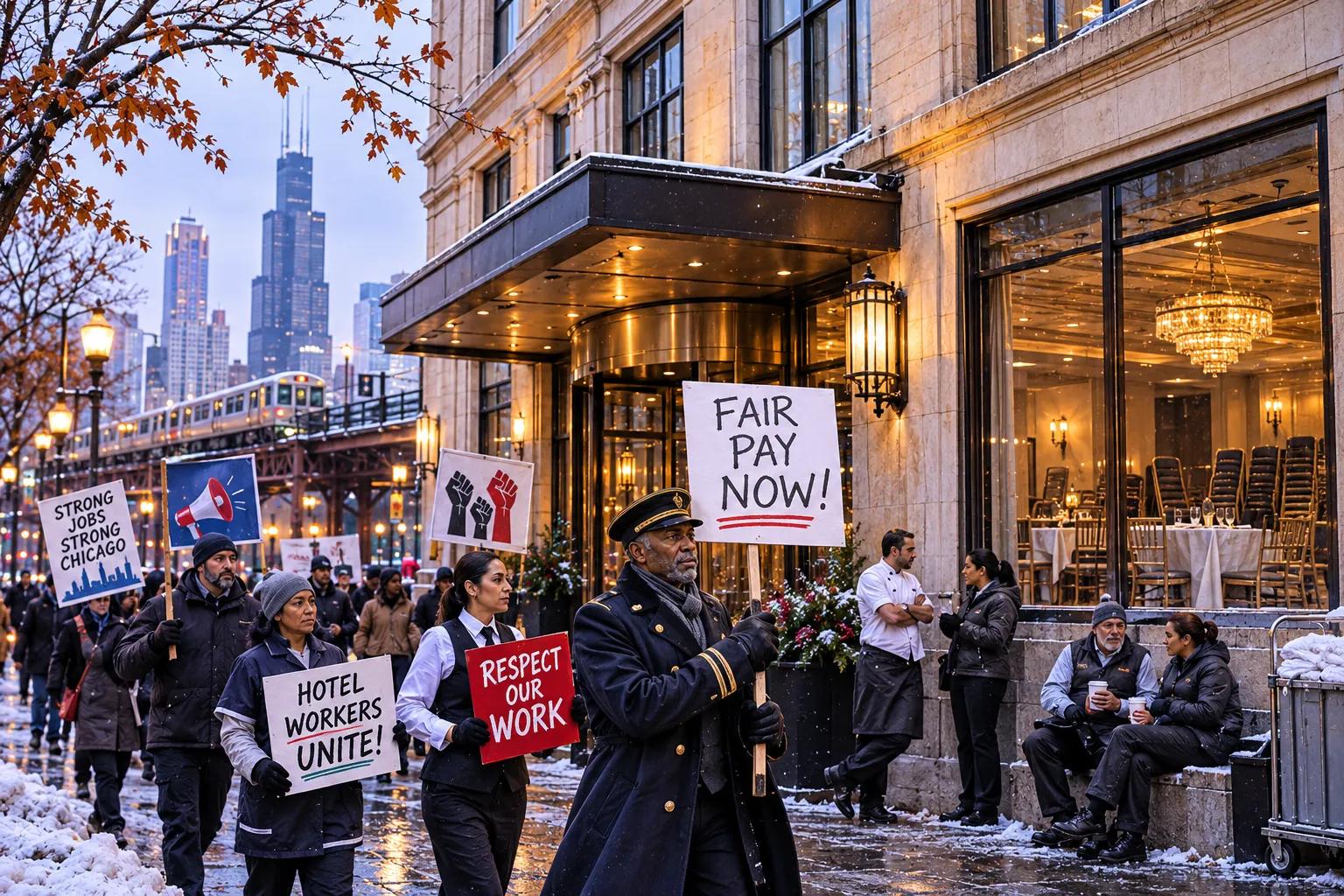
Here’s how that looks in real life. In Chicago, contracts for about 7,000 UNITE HERE Local 1 hotel workers at 46 hotels expired on Aug. 31, 2026. Walkouts reached eight of those hotels. At the other 38, people kept working under the expired terms while talks went on.
If an agency places you at a union venue
This is where a lot of event workers get confused. A CBA covers the people in the group it was bargained for, usually the venue’s own employees in certain jobs. If an agency employs you and sends you to a union hotel, the hotel’s contract usually doesn’t set your pay. Your agency does.
Some union contracts also set limits or rules for how a venue uses agency or subcontracted workers. And stage work often runs differently: many venues get extra stagehands through the union’s own overhire list, so those workers are paid under the contract.
Common questions
Best practices
Ask who your employer is It tells you whose contract or policy sets your pay for the shift.
Confirm bookings during talks When a contract is open, confirm the address, call time and pay in writing.
Common mistakes
Assuming a union venue means a union rate If an agency employs you, the venue’s contract usually doesn’t set your pay. Ask how your rate is set.
Thinking right-to-work means no unions Unions and contracts exist in right-to-work states. Workers just can’t be made to pay the union.
Thinking an expired contract means no rules The old terms generally keep applying while both sides bargain.
Expecting one rule for every city Jurisdiction and pay are set contract by contract, so a show in one city runs differently in another.